Opening business accounts sooner, with less manual handling.
Service blueprinting, redesigned flows and enterprise design-system contribution.
4–5 business days → immediate
Eligible business customers could open immediately instead of waiting for manual processing.
+43% site conversion
Launch-day team result for the new account-opening experience.
Problem
Customers met confusing application steps and eligibility checks, and some waited days while accounts were handled manually. The journey also crossed teams and systems.
Solution
I used research and service blueprints to redesign the full form experience, simplify the journey and migrate it to the new design system.
Outcomes
Immediate opening for eligible business customers; fewer clicks and clearer, more accessible UI; a product-card pattern reused across experiences; and a +43% site-conversion launch-day team result.
My role
Product Designer: customer research, service blueprinting, form and interface design, delivery alignment. I contributed a reusable product-card pattern to the new enterprise design system.
Customers had to work through unclear questions and identity checks before they could open an account. Some eligible applications then moved into manual handling, adding a wait of four to five business days.
Confusion over business and personal login, verification and unexpected form questions made it harder to continue confidently. The team had to work across systems and ownership boundaries to resolve those customer problems.
Concept illustration of research tools. No participant material is shown.
02 / Solution✿
From service evidence to product decisions.
I used research, service blueprints and flow design to connect customer needs with delivery priorities and enterprise patterns.
01 / 04
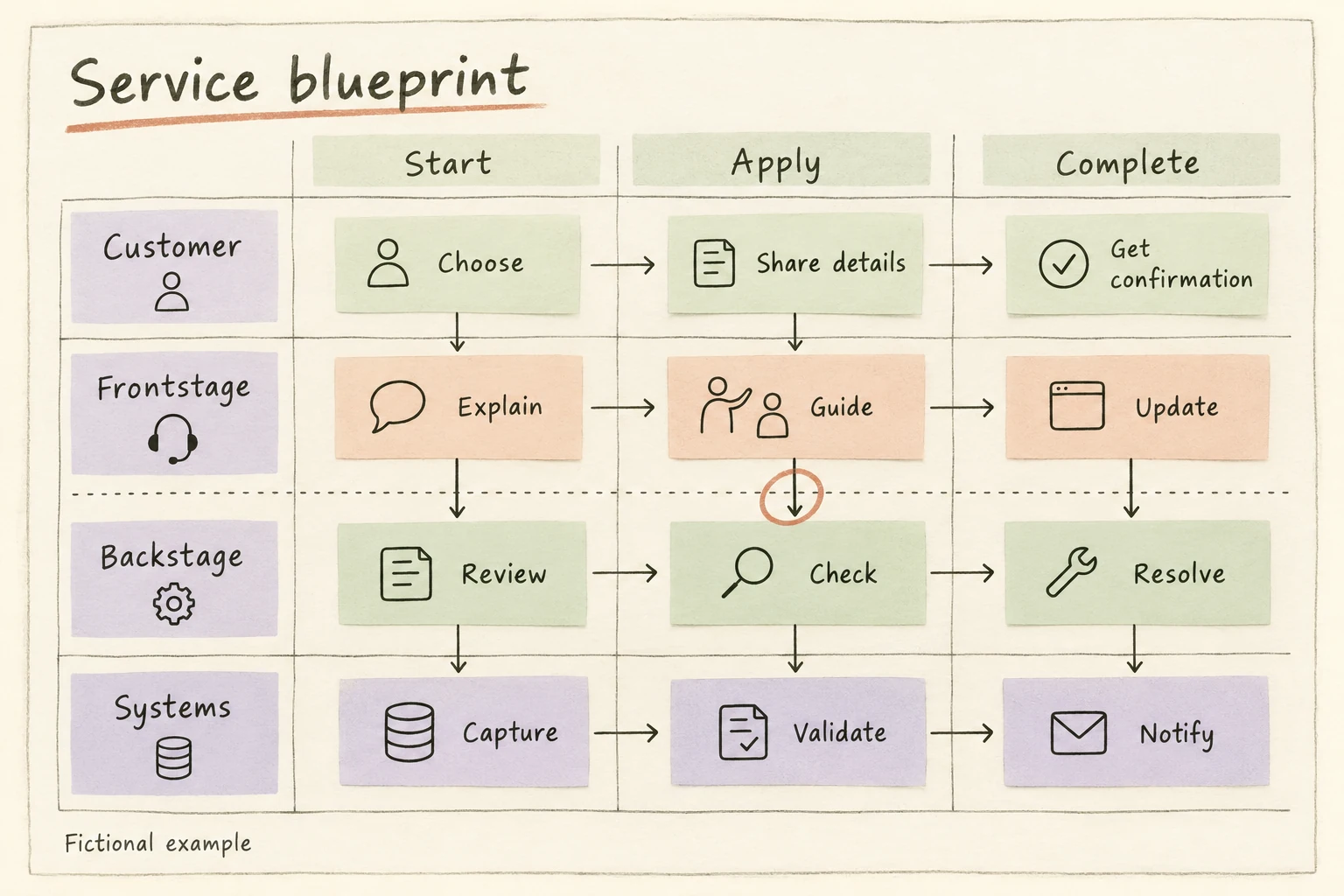
See where the form depends on the service.
Service blueprint
I connected self-serve and assisted journeys to backend processes, handoffs and ownership boundaries.
Product and delivery decision
Use a shared service view to prioritise what our team could build and where we needed other teams.
Business value
Make the causes of waiting and manual handling visible alongside the interface problems.
Fictional service blueprint illustrating the method; no internal service map shown.
02 / 04
Make the form easier to finish.
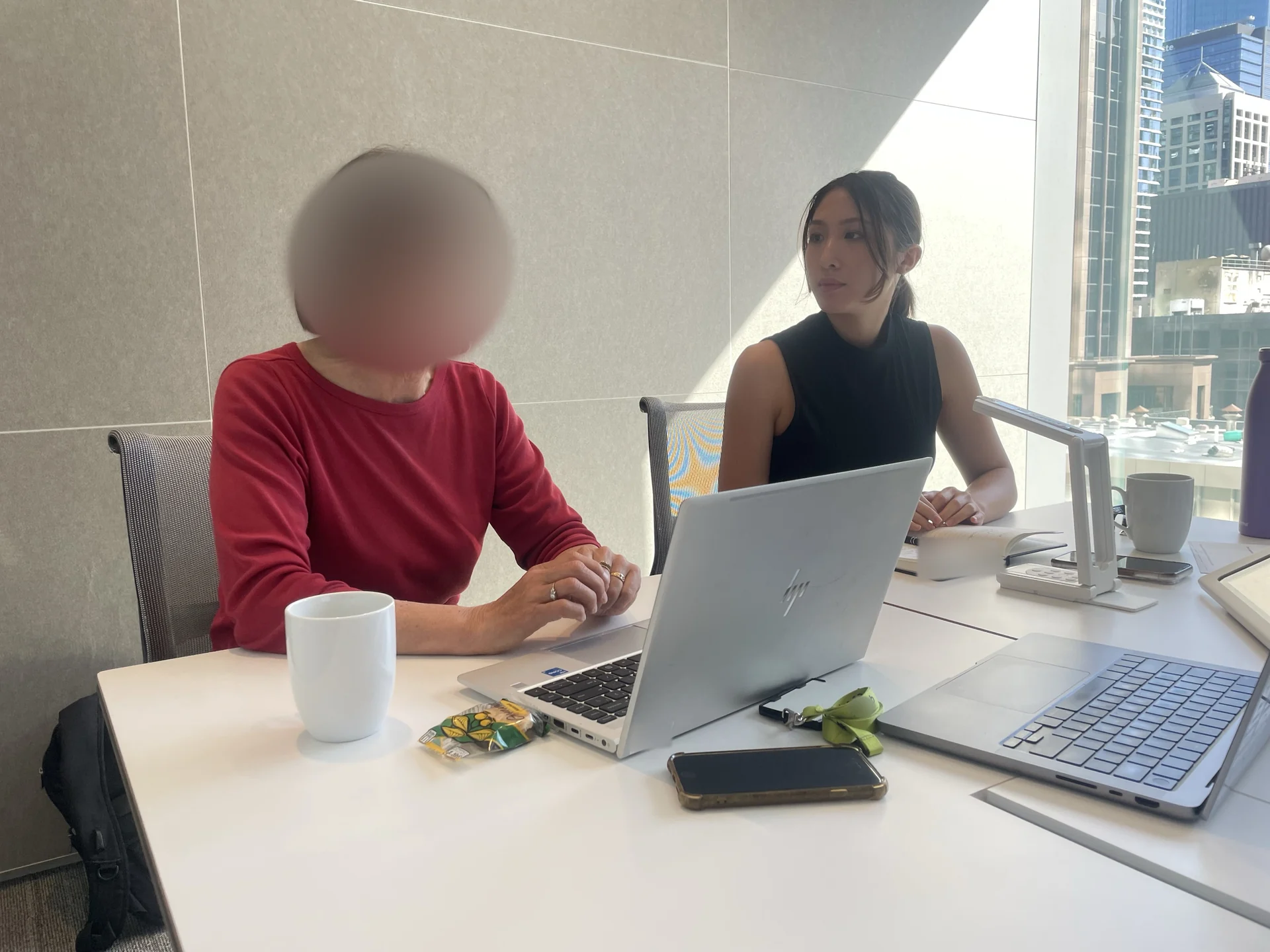
Customer interviews and analytics
In a small research cohort, 4 of 4 new-customer participants could not verify identity online. Adobe Analytics showed a 37.5% drop at identity verification. These findings informed the form redesign.
Design decision
Redesign the form flows and guidance around how customers move through the application, alongside the interface uplift.
What changed
The redesigned full experience reduced clicks and made guidance and interface states clearer and more accessible.
Customer research with Kim. Customer identity and readable identifiers obscured.
03 / 04
Give eligible customers a digital route.
Eligibility and flow design
Some eligible business customers faced manual processing and a wait of four to five business days.
Product decision
Work through eligibility and customer screens with the team so eligible applicants could follow a digital route.
Released outcome
Eligible business customers could open immediately, reducing the need for manual processing.
Current public step illustrating the digital route.
04 / 04
Fill a gap in the new design system.
Design-system contribution
The new enterprise design system needed an accessible product-card pattern that could work across NAB’s product origination experiences.
Design decision
I combined components into a reusable product-card pattern, designed to meet accessibility standards and show product information consistently across origination journeys.
Enterprise reuse
A shared, accessible pattern designed for reuse across all NAB product origination experiences, so teams could build on the same foundation.
Reference-based illustration of the shared card structure in review and confirmation, using fictional product and account details.
03 / Outcomes✿
Faster opening. Patterns that travel.
Immediate opening, less manual handling
Eligible business customers could open immediately instead of waiting through manual processing.
Consistency built into the form
I migrated the application to the new, Material-based design system. Shared components brought consistent behaviours and accessible interaction patterns across the journey.
Reuse across product origination
I contributed an accessible product-card pattern to the new enterprise design system, designed for reuse across NAB’s product origination experiences.
Launch-day team result
The team reported +43% site conversion on launch day.
The live application, step by step.
Step through selected screens from the updated application.
Examples from the live, updated end-to-end form, not a before-and-after comparison.
01 / 04
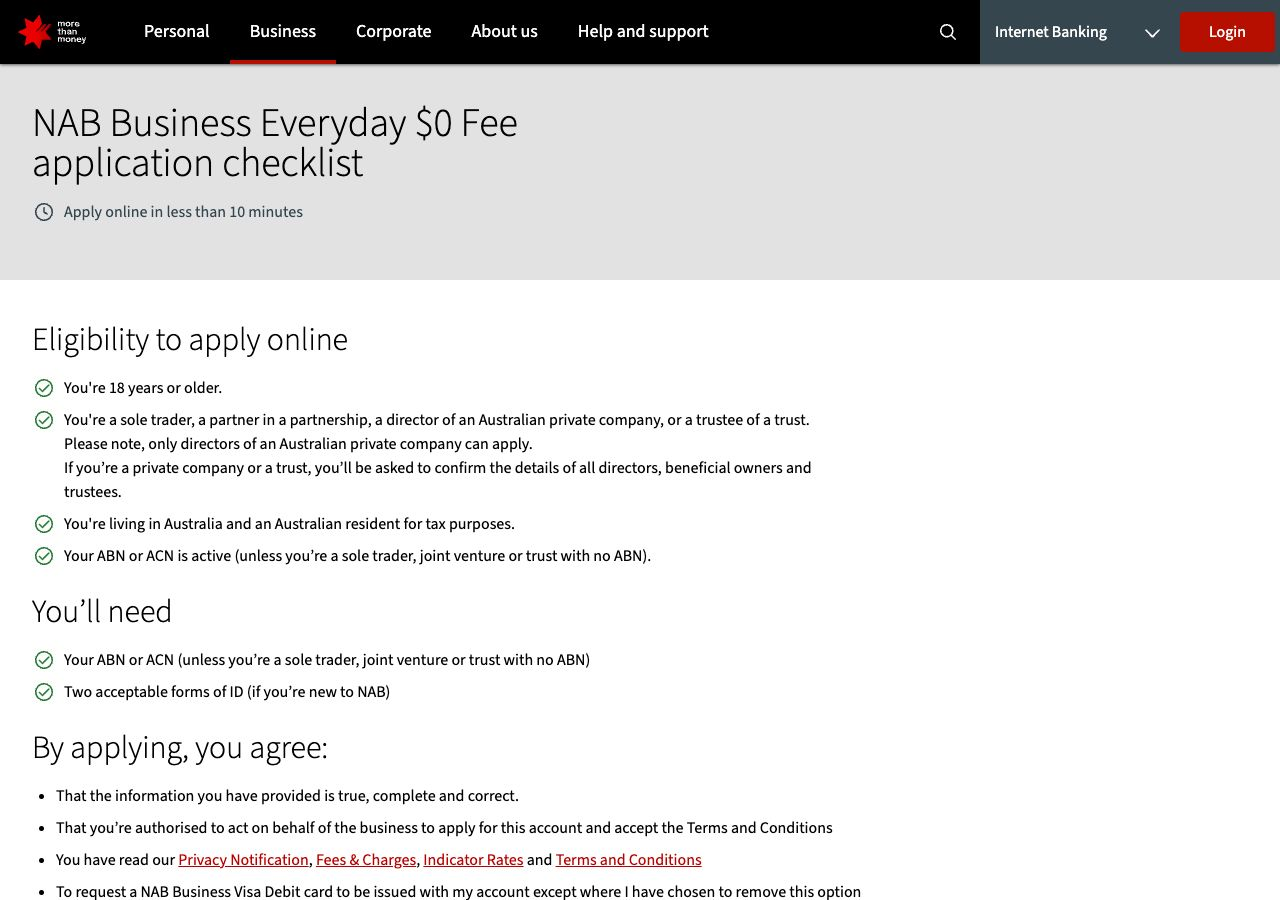
Set expectations before the form.
The public checklist brings eligibility and the information customers need into the starting journey.
1Check eligibility first.
2Know what to have ready.
12
02 / 04
Give existing and new customers a clear starting point.
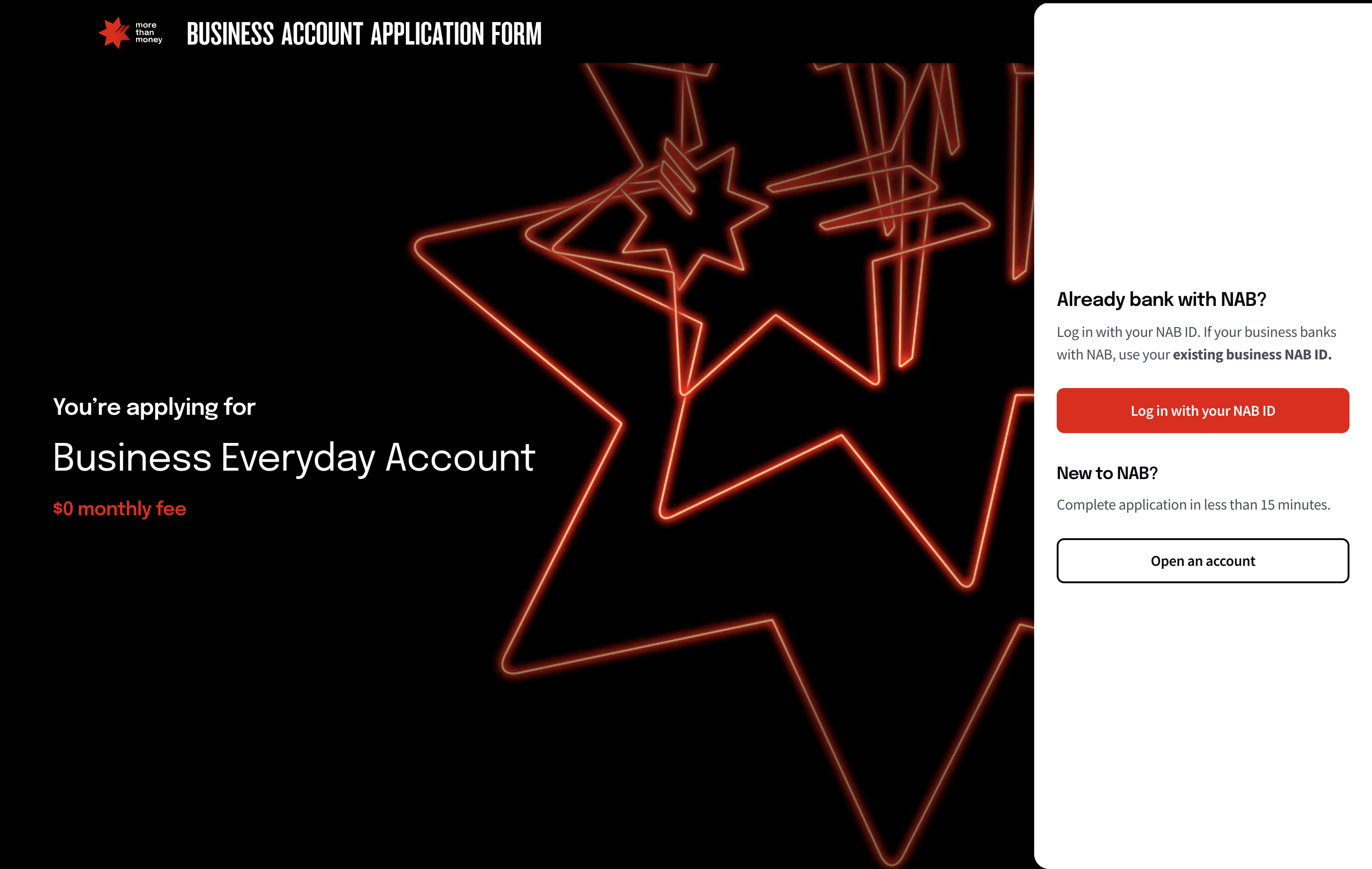
The existing-customer route specifies a business NAB ID. New customers have a separate way to begin.
1Clarify which login to use. Customers confused personal and business logins.
2A separate route for new customers.
12
03 / 04
Explain the lookup and offer an alternative.
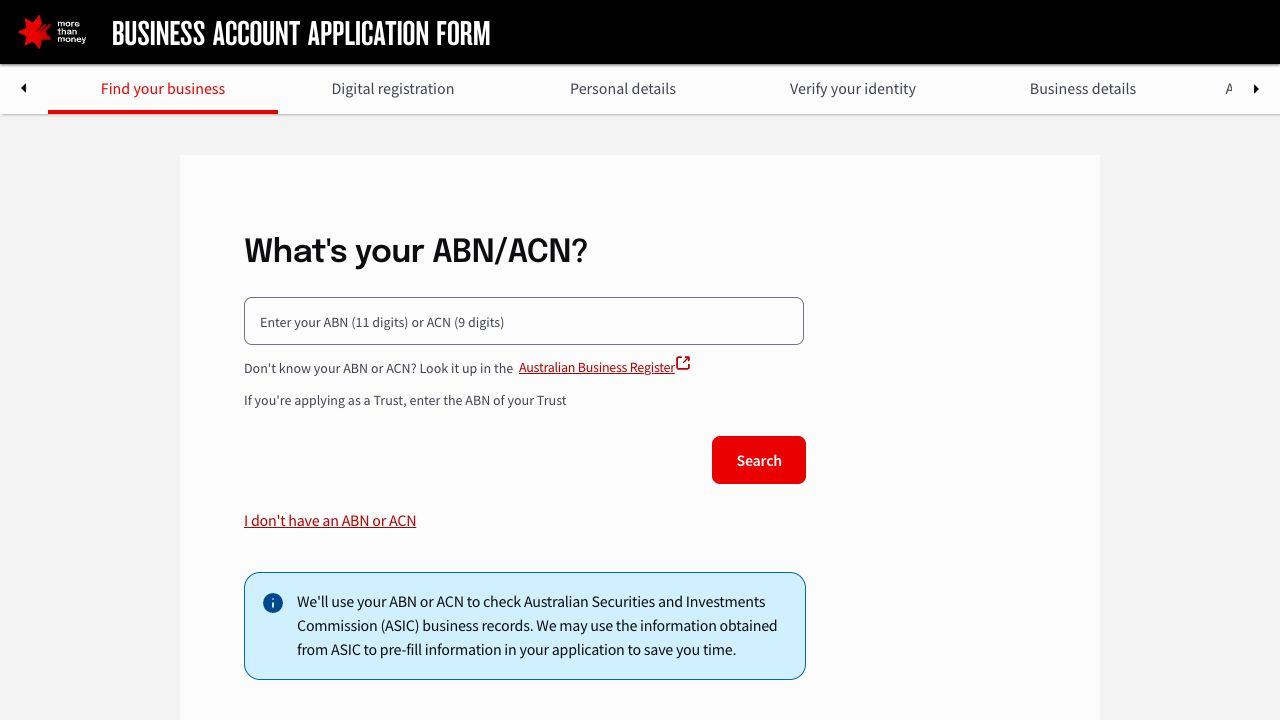
The form explains how business records can prefill the application and offers an alternative when a business identifier is unavailable.
1An alternative to identifier lookup.
2Explain why the information is needed.
12
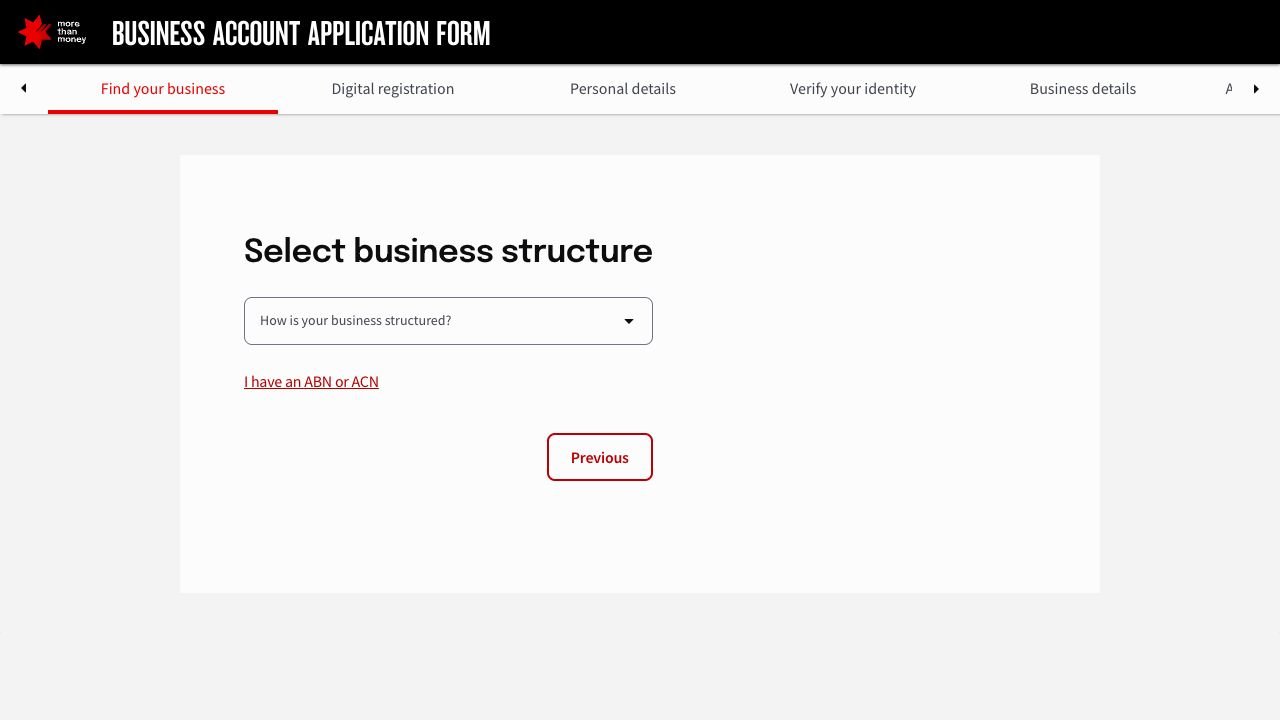
04 / 04
Make the alternative route part of the application.
The live form asks customers about their business structure. Eligible business customers can complete a digital account-opening route.
1Route the journey by business structure.
1
04 / My role✿
From service blueprint to shipped form.
I was the Product Designer across customer research, service blueprinting, full form and interface design, and delivery alignment. I contributed a reusable product-card pattern to the new enterprise design system.
How the work took shape
Sep 2024
Discovery
Friction findings
I investigated friction in the application journey.
Dec 2024–Jan 2025
Research priorities
Priorities defined
I connected research and analytics to delivery priorities.
Apr 2025
Service blueprint
Service handoffs
I mapped customer journeys, systems and ownership.
Jul–Sep 2025
Design and system
Form patterns
I redesigned flows and contributed a reusable product-card pattern.
Jan 2026
Team launch
Form released
The team launched the redesigned application.
Understand the experience
Moderated in-person customer interviews, synthesised earlier research and partnered on analytics.
Connect the service
Mapped customer journeys to backend processes and highlighted problem points and ownership boundaries.
Navigate delivery
Worked with product, solution design, QA and other teams to decide what to build and prioritise across dependencies.
Design the form and system
Migrated the full experience to the new design system, with fewer clicks, clearer UI and improved accessibility.
Internal screens, participant details and raw research are kept private.